

What Makes Olewave's Speech Data Cleaning Pipeline Effective and Unique
How Olewave's Olign pipeline turns raw audio into production-ready ASR/TTS training data with validated transcripts, word-level timestamps and confidence scores, without human labelers.

Olewave's state-of-the-art and highly customizable speech data cleaning pipeline seamlessly integrates with its speech data collection pipeline, together forming the Olewave's speech data curation pipeline. This end-to-end system is meticulously designed to deliver high-quality, consistent, and cost-effective speech datasets at scale, tailored for a wide range of downstream applications. Additionally, we are offering large-scale, cost-effective speech datasets curated through our pipeline, available in multiple languages and covering diverse topics.
The figure below illustrates the streamlined workflow of our speech data cleaning pipeline, showcasing its ability to transform raw, unstructured speech data into polished, actionable datasets.
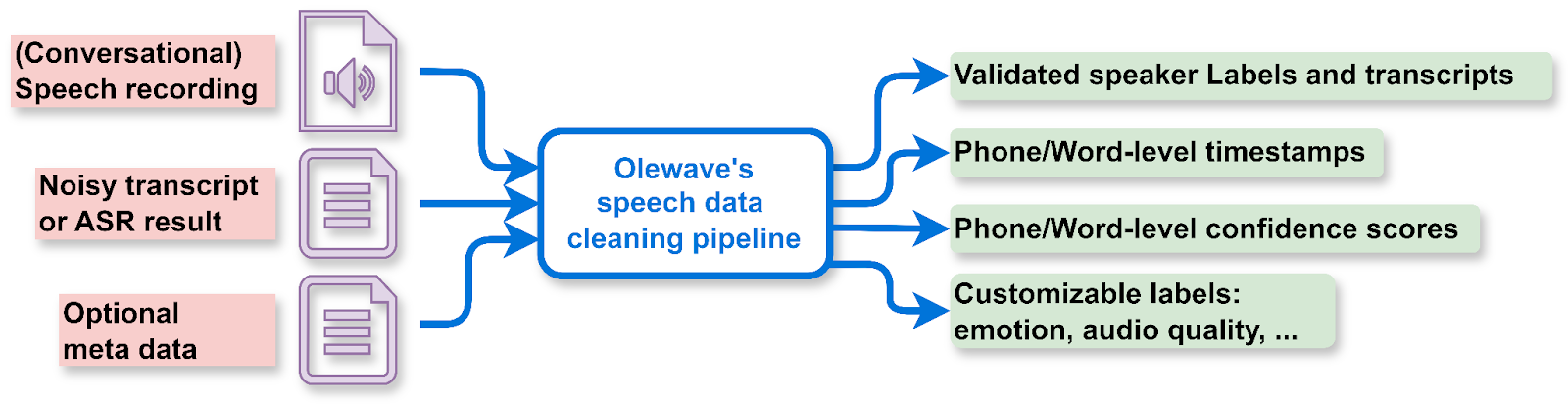
Our pipeline offers several advantages.
- Effective. It produces validated speaker labels and transcriptions, accurate word timestamps and not-overconfident confidence scores compared with Whisper and other open-source tools.
- Robustness. It handles improvised conversational speech, including scenarios with speaker overlap and transcripts containing ASR errors.
- Extensible. It leverages optional metadata and can be upgraded to incorporate additional modality for increased label reliability. The pipeline also supports plug-and-play integration of various Olewave's or client's own label tagging models (e.g., emotion, semantics, …).
- Efficiency. It runs quickly and is cost-effective, as it requires no or little GPU resources.
Additionally, if your goal is to have human annotators refine Automatic Speech Recognition (ASR) results, the output of our pipeline can significantly reduce labeling costs in two ways.
- Precisely highlighting words with accurate timing information, enabling annotators to quickly locate and review mumbled or unclear segments without repeatedly listening to the entire audio.
- Guiding annotators to focus on words with mid-range confidence scores, minimizing the need to review every word and streamlining the correction process.
By providing these targeted insights, our pipeline enhances efficiency, reduces manual effort, and ensures a more cost-effective annotation workflow.
Below are the visualized examples of the pipeline's output, showcasing speaker label, word-level timestamps and confidence scores.
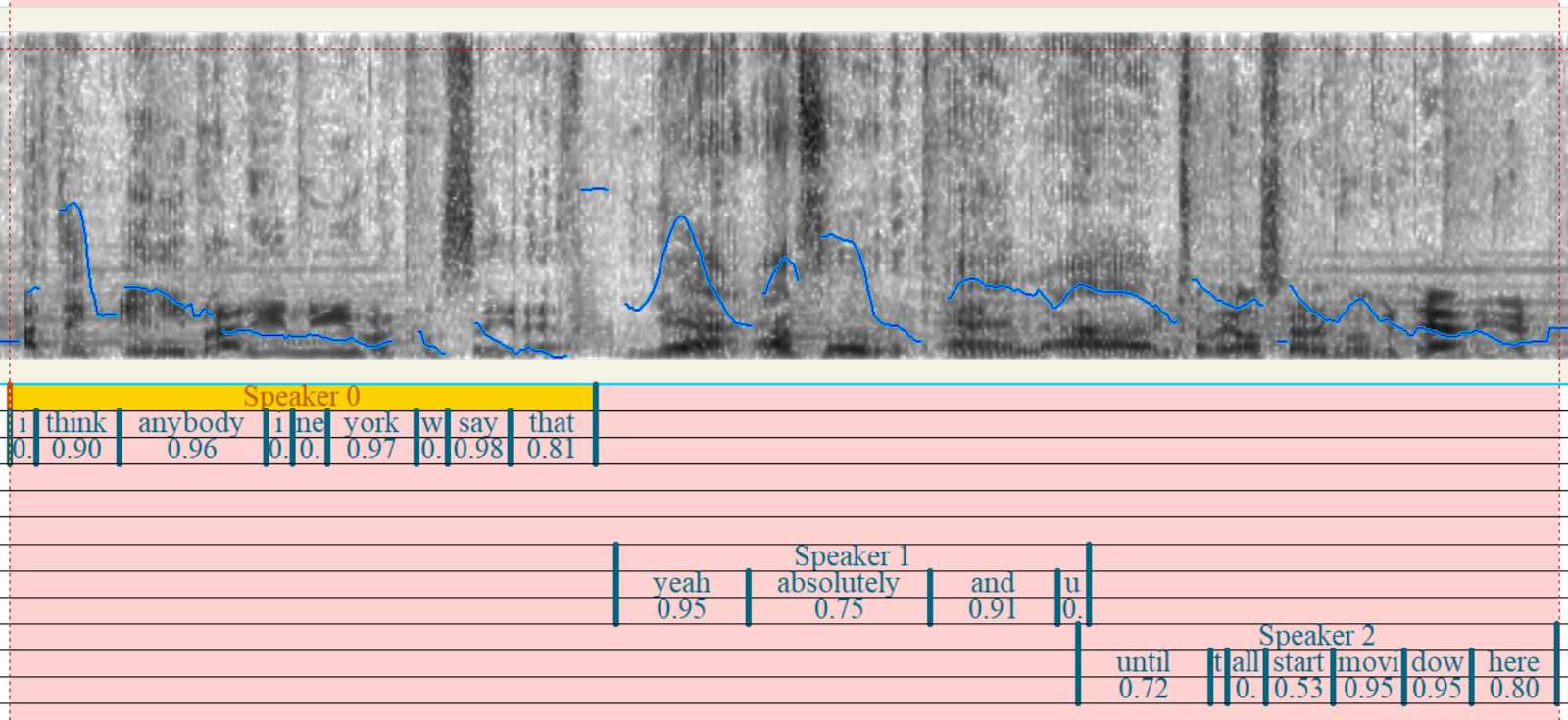
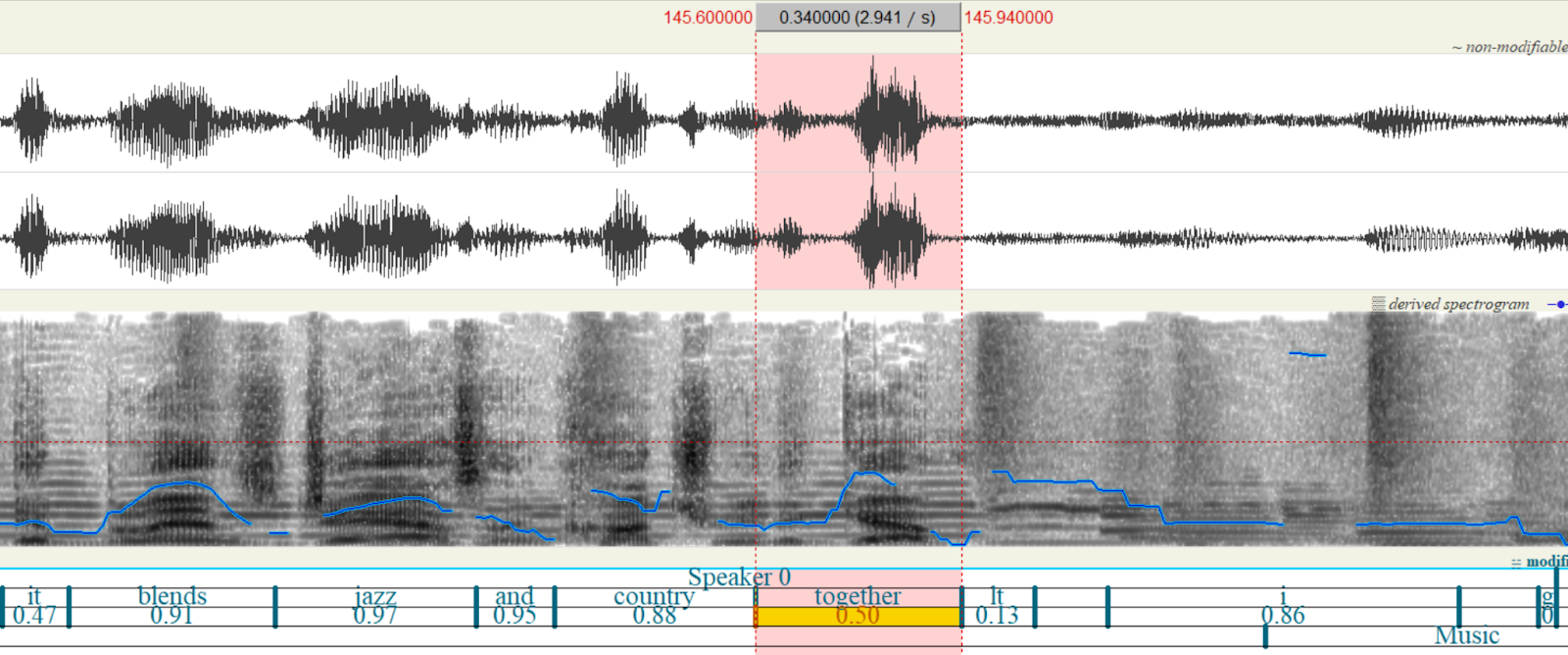
It is widely recognized in both academia and industry that large End-to-End (E2E) frameworks and large E2E ASR models have inherent limitations when it comes to producing accurate word-level timestamps and reliable word-level confidence scores, respectively.
To address these limitations, we leverage our deep expertise in non-End-to-End speech-to-text alignment techniques and have developed sophisticated procedures that incorporate metadata information. This approach allows us to effectively clean non-spoken content (e.g., filler words, background noise transcriptions) from transcripts, ensuring higher accuracy and reliability in the final output.
Here is a snippet of word-level json output of the data pipeline. The 'speaker' field indicates the id of the speaker in this recording. The 'start_time' and 'end_time' fields are in seconds indicating the time span of the speaking speaker. The 'block' field contains one or multiple consecutive utterances from the same speaker. Each utterance has its own starting time, ending time, transcript, speaker overlap indicator, and confidence score. When an 'overlap' field is true, it means the current segment has a speaker overlap with adjacent segments. The confidence score ranges from 0 to 1.
{
        "speaker": 0,
        "start_time": "47.18",
        "end_time": "49.83",
        "block": [
            {
                "start_time": "47.18",
                "end_time": "49.83",
                "transcript": "music-related jobs compared to New York and LA.",
                "overlap": false,
                "word_details": [
                    {
                        "start_time": "47.18",
                        "end_time": "47.53",
                        "word": "music",
                        "confidence": "0.97"
                    },
                    {
                        "start_time": "47.53",
                        "end_time": "47.89",
                        "word": "related",
                        "confidence": "0.79"
                    },
                    {
                        "start_time": "47.89",
                        "end_time": "48.44",
                        "word": "jobs",
                        "confidence": "0.98"
                    },
                    {
                        "start_time": "48.44",
                        "end_time": "48.90",
                        "word": "compared",
                        "confidence": "0.96"
                    },
                    {
                        "start_time": "48.90",
                        "end_time": "48.96",
                        "word": "to",
                        "confidence": "0.17"
                    },
                    {
                        "start_time": "48.96",
                        "end_time": "49.08",
                        "word": "new",
                        "confidence": "0.97"
                    },
                    {
                        "start_time": "49.08",
                        "end_time": "49.37",
                        "word": "york",
                        "confidence": "0.98"
                    },
                    {
                        "start_time": "49.37",
                        "end_time": "49.49",
                        "word": "and",
                        "confidence": "0.92"
                    },
                    {
                        "start_time": "49.49",
                        "end_time": "49.83",
                        "word": "la",
                        "confidence": "0.56"
                    }
                ]
            }
        ]
    },