


Olign Aligns Recordings of Nearly Three Hours as Precisely as Ten-Minute Ones
Olign 1.2 aligns recordings of nearly three hours as precisely as ten-minute ones. On the longest files, the mean word timing error fell from 122 ms to 23 ms.
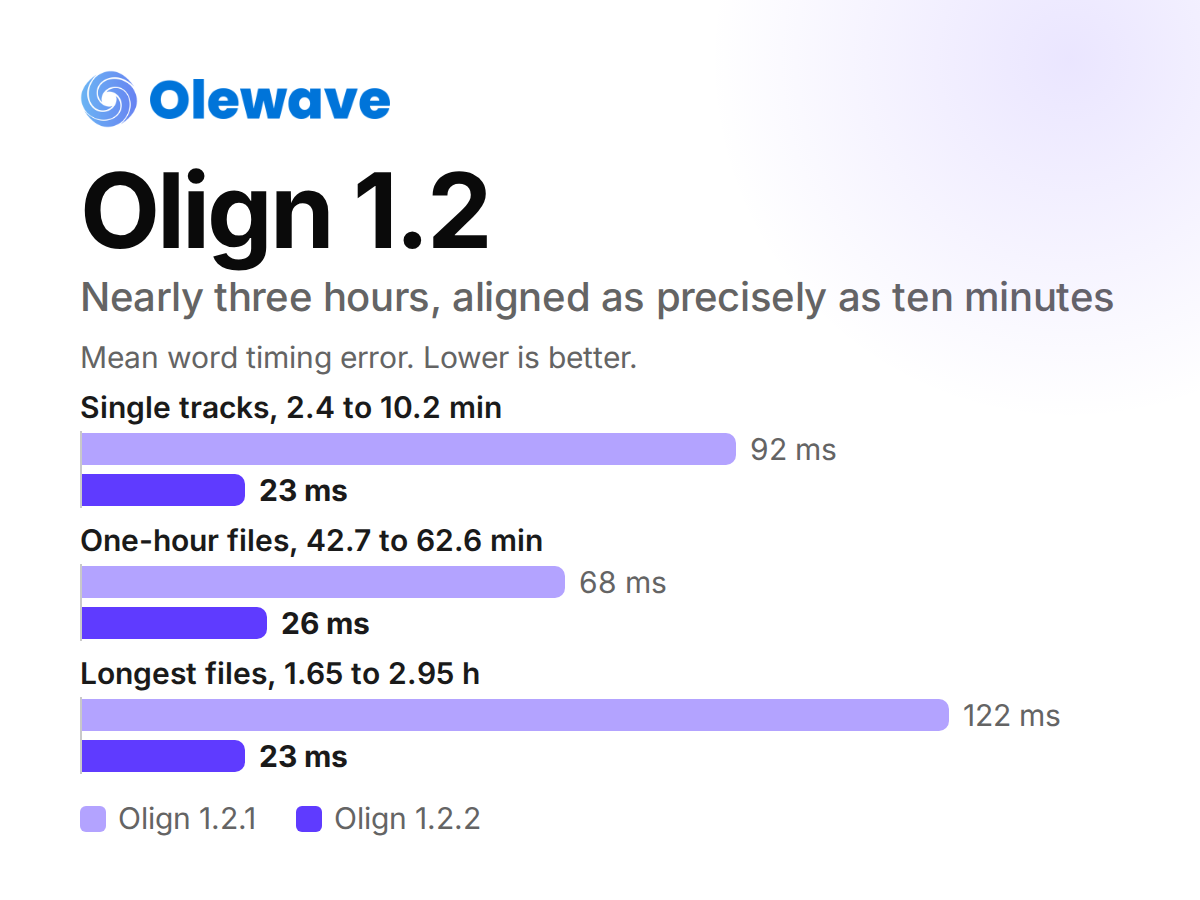
Olign 1.2 now aligns a recording of nearly three hours as precisely as a ten-minute one. The update, Olign 1.2.2, is live today.
Send a whole interview or an hour-long file with its transcript, and every word comes back with its start and end time. You no longer need to cut your audio into short clips first.
On the longest files, up to 2.95 hours, the mean word timing error fell from 122 ms in Olign 1.2.1 to 23 ms in 1.2.2. Word timestamp F1 at 20 ms is 0.775 on single interview tracks and on the longest files alike. Every Olign job runs on 1.2.2 today, and the API is unchanged.
How we measured
FA-Bench scored Olign 1.2.1 and 1.2.2 on a new long-form test. It uses conversational English from the Buckeye corpus, the interviews of the 8 speakers in FA-Bench's Buckeye test set. Each file goes to Olign whole, with its full transcript. The test has three sets of files.
- Single tracks. The 49 interview tracks, each sent as it is. They run 2.4 to 10.2 minutes, and the median is 9.5 minutes.
- One-hour files. Each speaker's tracks joined end to end. That gives 8 files of 42.7 to 62.6 minutes.
- Longest files. The one-hour files joined the same way. Three speakers' hours make a file of 2.80 hours, and three more make one of 2.95 hours. The last two speakers make a file of 1.65 hours.
Where two recording sessions meet, there is half a second of digital silence. The corpus does not transcribe the interviewer, so in every file the interviewer's speech is muted to digital silence, with 10 ms fades. So are the few words that FA-Bench's standard test leaves out. No transcribed word is touched. In interview recordings the interviewer is usually on another channel, so it makes sense to test with silence in their place.
Every set is scored on the same 4,513 test utterances. They are the ones FA-Bench scores in its standard test, where the speech arrives cut into short utterances.
Word timestamp F1 at 20 ms is the share of word start and end times that land within 20 ms of the hand labels, with precision and recall combined. Higher is better.
Mean timing error, or word timestamp MAE, is the average distance of each matched word's start and end from the hand-labelled time, in milliseconds. A boundary that two words share counts once for each word. Lower is better. It is a different measure from the word boundary error in our Olign 1.1 post, which counts each boundary once.
Olewave makes both FA-Bench and Olign, so this post compares Olign only with its own earlier releases. FA-Bench is preparing the long-form test as a fully documented benchmark.
The same precision at every length
Word timestamp F1 at 20 ms. Higher is better.
| Files | Olign 1.2.1 | Olign 1.2.2 |
|---|---|---|
| Single tracks, 2.4 to 10.2 min | 0.760 | 0.775 |
| One-hour files, 42.7 to 62.6 min | 0.759 | 0.774 |
| Longest files, 1.65 to 2.95 h | 0.760 | 0.775 |
Mean timing error. Lower is better.
| Files | Olign 1.2.1 | Olign 1.2.2 |
|---|---|---|
| Single tracks, 2.4 to 10.2 min | 92 ms | 23 ms |
| One-hour files, 42.7 to 62.6 min | 68 ms | 26 ms |
| Longest files, 1.65 to 2.95 h | 122 ms | 23 ms |
On Olign 1.2.2, F1 is 0.774 or 0.775 at every length, and the mean timing error is 23 to 26 ms. The longest files come back as precisely as single tracks.
Against 1.2.1, F1 rose by 0.015 at every length. The mean timing error fell from 92 ms to 23 ms on single tracks, from 68 ms to 26 ms on one-hour files, and from 122 ms to 23 ms on the longest files.
Whole recordings and pre-cut clips
FA-Bench's standard test gives Olign the same speech already cut into its 4,513 short utterances. It scored Olign 1.1.3 there, on the same word edges with the same scorer.
| What Olign was given | F1 within 20 ms | Mean timing error |
|---|---|---|
| The same speech, cut into utterances first (Olign 1.1.3) | 0.775 | 16.1 ms |
| Single interview tracks, sent whole (Olign 1.2.2) | 0.775 | 23 ms |
F1 at 20 ms is 0.775 either way. The mean timing error is about 7 ms higher on whole tracks. About 4 ms of that gap comes from a few word edges that land more than a second off, 0.16% of all word edges. The rest comes from words near the start and end of the test utterances.
So you can send the whole recording as it is. You no longer need to cut it first.
What changed for long recordings
Earlier releases could miss speech next to a long silence. A run of words could then land far from where it was said. Olign 1.2.2 keeps its place through long silences, so those words now land where they were said, at every length we tested.
Available now
Olign 1.2.2 is live for every Olign job. You reach it through the Olign API at
api.olewave.com/olign/v1 or the olign Python package, version 1.2.2 on
PyPI. There is nothing to switch on, and your existing requests keep working.
Align a long recording
Install the package and put your API key in OLIGN_KEY.
pip install olign
export OLIGN_KEY=gvk_your_key
One line sends a whole recording with its transcript and writes a Praat TextGrid with a words and a pauses tier.
olign align interview.mp3 --transcript interview.txt --textgrid
In Python, olign.Client sends the job and waits until the words are ready.
from pathlib import Path

import olign

client = olign.Client()  # reads OLIGN_KEY
result = client.align("interview.mp3", transcript=Path("interview.txt"))

print(len(result.words), "words aligned")
result.to_textgrid("interview.TextGrid")
result.to_srt("interview.srt")
One job takes up to 3 hours of audio, in a file of up to 100 MB.
Next steps
-
Start with the Olign API
Sign up and get free credits to align your own recordings. -
Install the olign package
Version 1.2.2 is on PyPI.